
The axeman cometh
© 2017 The Domestic Alien
No, this blog is not about Thor—though if any of Chris Hemsworth’s people is reading this, please feel free to contact me, and I can arrange that. And yes, I know that Thor had a hammer, not an axe, but please indulge the creative licence I’ve taken with that. You’ll soon see why.
Ever since the wonderful soul who invented them did so, guitars have fascinated humankind—perhaps because, in the right hands, they give sound to emotions. The most dedicated appear to become at one with their guitar, and are seldom pictured without it. I fondly remember seeing a teenager practising as he walked to and from school each day, such was his love for his axe. Young as he was, he already knew that one’s love for a guitar is no passing fancy, but a deep and enduring passion.
History has been graced with a long and distinguished procession of amazing guitars, and equally amazing guitarists. Here are the backstories of only some of the most notable:
Lucille (BB King)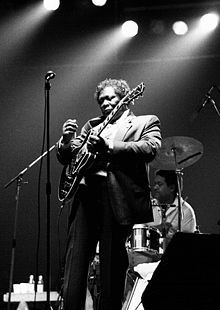
BB was playing at a dance in Arkansas when two men in the audience started fighting and knocked over the kerosene-fuelled heater that was warming the hall. With flames rapidly spreading, the building was evacuated, after which BB realised he’d left his beloved guitar inside. So he did what any guitarist would do—and went straight back into the burning building to retrieve the precious axe.
On learning that the two men had been fighting over the affections of a girl named Lucille, he named his guitar—and all those he subsequently owned—Lucille, to remind him to never again do anything as silly as entering a burning building or getting into a fight over a woman.
Old Brownie (Eric Clapton)
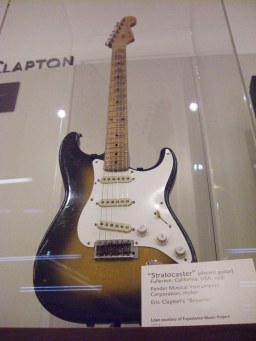 This imaginative name was given to a brown Fender Stratocaster favoured by Eric Clapton during the 1970s, particularly during his Derek and the Dominoes days (try saying that three times fast!) Purchased for $400 while Clapton was with the legendary three-piece, Cream, Old Brownie became the most expensive guitar ever sold in 1999 when it fetched $497,500 at auction.
Clapton had donated the axe to raise funds for the Crossroads Centre, the alcohol and drug treatment centre he co-founded following his own well-documented struggle with, and recovery from, addiction. Old Brownie is currently enjoying a comfortable retirement at the Museum of Pop Culture in Seattle Washington.
Old Blackie (Eric Clapton)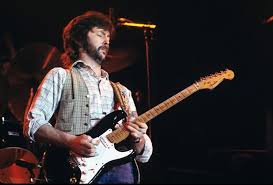
Old Blackie was, in fact, assembled from the best parts of three different Fender Stratocasters Clapton bought from Tennessee’s Sho-Bud guitar shop. Nashville Luthier Ted Newman Jones put together this master axe, which Clapton debuted at 1973’s Rainbow Concert and continued to play well into the 1990s.
In 2004 Old Blackie surpassed the auction return of former stablemate Old Brownie when it sold for $959,500—with funds once again supporting the Crossroads Centre.
Although something of a recluse these days, Old Blackie has been spotted on the odd occasion—once when Clapton recorded a new guitar solo for ‘Bad Love’ and was filmed while doing so for use in a Honda television commercial; and onstage during some live performances at the Royal Albert Hall in the early 1990s.
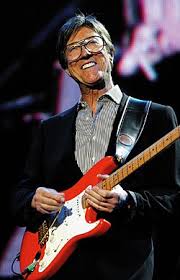 Fiesta Red Strat (Hank B Marvin)
I haven’t been able to find a specific name for the red Stratocaster Hank favours, but it’s so synonymous with its maestro that it could easily be called the Hank B Marvin—and probably is, by many. This iconic axe and its expert wielder have inspired countless others, including consummate fretmaster Mark Knopfler.
Hank himself had been inspired to purchase the Strat on seeing Buddy Holly with one on the cover of a Crickets album, and thinking ‘it looked pretty cool’. First appearing with Hank in 1959, the Strat replaced an Antoria whose neck had been badly damaged. With Cliff Richard and The Shadows rapidly gaining popularity, the boys decided to buy the best guitar they could afford, so ordered the Strat from the US. And the rest is history …
Jimi Hendrix’s flaming axe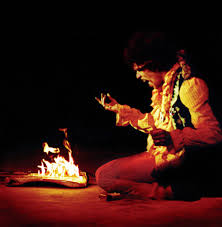
Described by The Rock and Roll Hall of Fame as ‘arguably the greatest instrumentalist in the history of rock music’, Jimi Hendrix is also renowned for two things—playing a right-handed guitar left-handed (and on occasion with his teeth, behind his back and while lying down), and setting his guitar alight—not once, but twice. Such is his legend that many are surprised to learn his mainstream career spanned a mere four years.
Jimi’s axe of choice was a black 1968 Stratocaster with maple neck, though he began using different models, including Gibson Flying Vs and Les Paul Customs, in the latter part of his career.
In London in 1967, while chasing media exposure for The Jimi Hendrix Experience, they were advised to do something that would eclipse The Who’s stage show, where the band smashed their instruments. That conversation planted the seed for Hendrix to set fire to his guitar at the end of his set at a London venue—a spectacular stunt that earned him the monikers ‘Black Elvis’ and ‘The Wild Man of Borneo’.
This lesser-known precursor has been all but forgotten in the wake of Jimi’s more notorious pyrotechnics at the Monterey Pop Festival, where he staged his notorious ‘guitar sacrifice’ that has been described as a perfect moment for rock’n’roll.
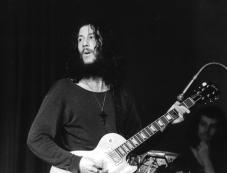 1959 Les Paul Standard (Peter Green-Gary Moore)
Perhaps the most poignant axe story of all involves two UK guitarists and one treasured guitar that they both loved. Peter Green, co-founder of Fleetwood Mac, suffered from bouts of depression and, at times, the effects of substance. During one prolonged patch of darkness Green found himself unable to play, so offered his much-loved 1959 Les Paul Standard to Gary Moore ‘so that it would have a good home’.
Moore, who was sometimes described as a ‘disciple’ of Green’s, loved the guitar but declined, being unable to pay Green what the axe was worth. With Green insistent that he should pay what he could and take the guitar, Moore sold the best guitar he had and gave the money to Green, thereby beginning a long and fulfilling relationship with the Les Paul that lasted some 25 years.
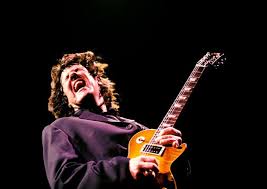
Subsequent money problems forced Moore to sell the beloved axe in 2006, just a few years before his death. But there’s a happy ending to the story—after passing through a few owners, the iconic Les Paul was acquired by Metallica’s Kirk Hammett, who has said ‘the best tribute is that it’s being played again instead of being neglected by people who only bought it for the investment.’
And no diehard guitarist, or guitar lover, would ever argue with that.
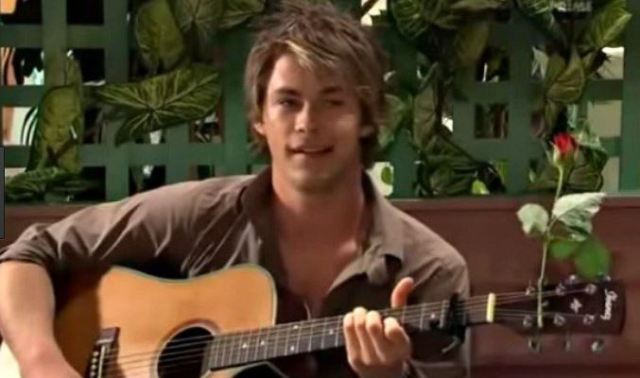
I told you this blog wasn’t about Thor, and it isn’t … but because I’m still hoping Chris Hemsworth’s people might contact me, I’ll close with a pic of a very young Thor with his axe of the day. I’m only sorry there’s no sound, as I understand the applause was thunderous (sorry!)
No, dammit. I’m not.

10 October 2017 © 2017 The Domestic Alien
#chrishemsworth #famousguitars #famousaxes
 The Domestic Alien
Pingback: A welcome from The Domestic Alien | The Domestic Alien